


Let’s be honest—documenting risks feels productive. You’ve identified threats, scored them, categorized them, and maybe even dropped them into a neat little spreadsheet or GRC platform.
But here’s the uncomfortable truth:
Just because you’ve documented your risks doesn’t mean you’re managing them.
And in today’s world of real-time cyber threats, supply chain exposures, and increasingly complex digital ecosystems, a static risk register can give you a false sense of security.
Risk registers are foundational. But far too many organizations stop there. They become checklist-driven. Audit-focused. Reactive, not resilient.
Here’s what that usually looks like:
That’s not risk management. That’s risk theater.
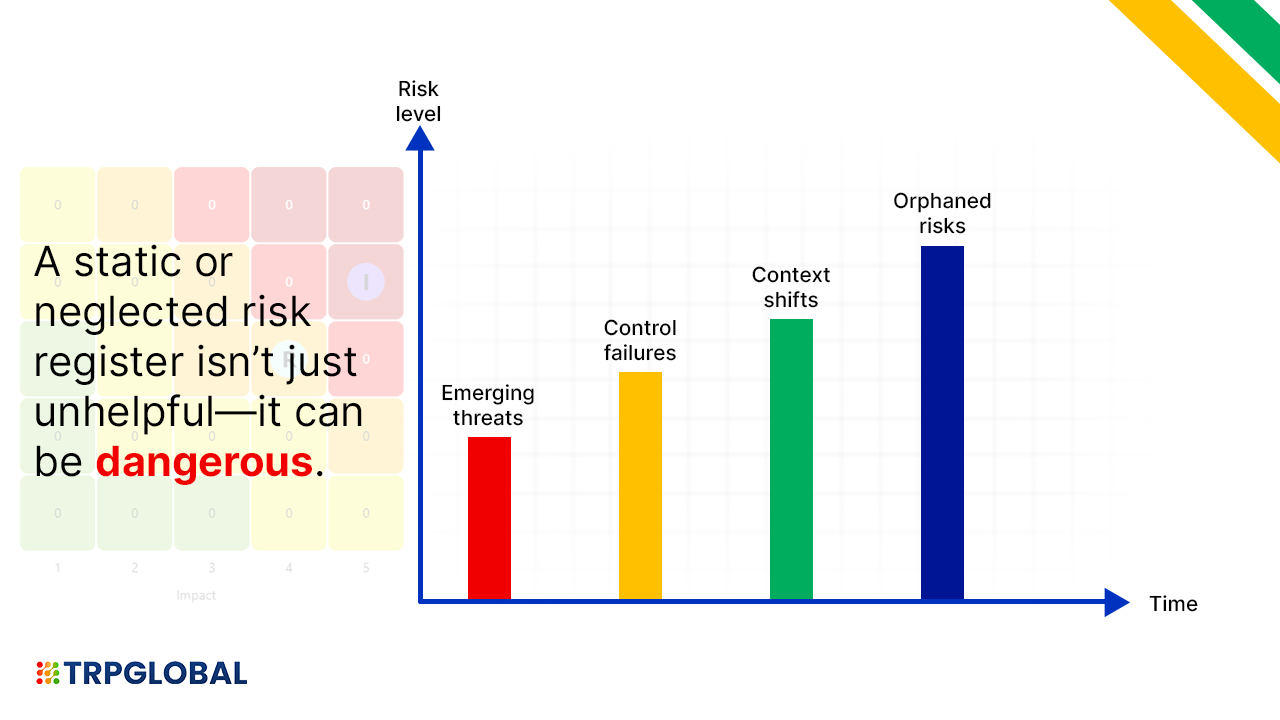
A static or neglected risk register isn’t just unhelpful—it can be dangerous.
A tech firm suffered a ransomware attack via a legacy file server. The risk had been logged two years earlier—but never reassessed, assigned, or remediated. It was buried at the bottom of the register with a "low" rating based on outdated business context.
Good question. Risk management is a cycle, not a checklist. And once a risk is documented, that’s when the real work begins.
Here’s what needs to happen next:
Not all risks are created equal. Once you've logged your risks, start asking:
Use a risk prioritization matrix that reflects business impact, not just theoretical likelihood.
Pro tip: Tie risks to critical business functions—not just assets.
Every risk in your register should have:
No owner = no progress. Period.
It’s not enough to list that “access controls are in place.” Are they effective? Are they tested? Do they actually reduce risk?
Start mapping risks to:
Then test those controls on a schedule. If they fail—update your risk score.
Quarterly reviews don’t cut it in a world where breaches happen in hours.
Build in:
This keeps your register alive—and keeps you ahead of threats.
Most risk registers are filled with technical jargon or vague categories like “data exposure” or “system downtime.”
That doesn’t help your leadership team make informed decisions.
Instead:
Every time you have a breach, a near miss, or even a critical alert—it should trigger a review of:
This creates a feedback loop that makes your risk register smarter over time.
Here’s the kicker: just 36% of organizations say their risk registers are reviewed in real time, according to a recent ISACA study. And yet, the same report shows that over 60% of breaches in 2024 stemmed from known but unmanaged risks—meaning the issue was on paper… but not in practice. That’s the danger of documentation without action. If your risk register isn’t updated, owned, and integrated into daily decision-making, it’s not a safety net—it’s a false sense of security. Because threats don’t wait for your next review cycle.
Bonus: What Most Organizations Still Get Wrong
Here are a few extra mistakes we still see far too often:
Risk shouldn’t live in a spreadsheet. It should live in the decisions your business makes every day.
A risk register is a starting point. But resilience is what keeps you running when things go wrong.
Don’t let your team fall into the trap of false confidence just because everything’s “documented.” The real question is: What are you doing with that information? If the answer is “not much,” then it’s time to rethink the entire approach.
If your risks are documented but not truly managed, we can help. Let’s talk about building a real-time, business-aligned risk strategy that goes far beyond the spreadsheet.
👉 Contact us to get started.

In our newsletter, explore an array of projects that exemplify our commitment to excellence, innovation, and successful collaborations across industries.