


Cybersecurity has never been more sophisticated. Organisations invest heavily in zero-trust architectures, advanced IAM, continuous monitoring, AI-driven threat detection, and hardened cloud security controls.
Yet breaches tied to third parties and vendors continue to rise.
Budgets are increasing. Controls are improving. Security teams are more capable than ever.
And still, organisations are compromised through partners they trust.
Why?
Because the most dangerous cyber weakness heading into 2026 isn’t a new exploit, malware strain, or external attacker.
It’s something more structural and far more dangerous:
The upstream attack surface is created by vendors, suppliers, and service providers operating outside your direct control but inside your trust boundary.
The Weakness: Trust Extending Beyond Visibility
Modern enterprises are no longer isolated environments. Every organisation operates inside a digital supply chain built on vendors.
These vendors often have:
Security programs assume:
But just like internal controls, vendor trust drifts away from reality.
And when that happens, attackers don’t break in — they log in.
What an Upstream Attack Really Is
An upstream attack occurs when threat actors compromise a vendor first and then move downstream into customer environments using legitimate access paths.
This includes:
From the attacker’s perspective, this is ideal.
They avoid perimeter defences.
They blend into normal activity.
They inherit trust automatically.
The organisation being attacked may never realise the breach originated elsewhere.
How Upstream Risk Quietly Forms Inside Every Enterprise
Upstream risk doesn’t appear overnight. It accumulates silently as ecosystems expand.
Vendors are added quickly to enable speed and scale.
Over time:
What started as controlled access becomes invisible exposure.
2. Vendor Security Is Assessed Once, Then Assumed Forever
Most organisations rely on:
But vendor environments change constantly.
They migrate to cloud platforms.
They outsource services.
They change tooling and staff.
Security posture shifts while trust remains unchanged.
3. Fourth-Party Risk Goes Unseen
Your vendor has vendors.
These subcontractors may handle:
Most organisations have no visibility into this layer.
Attackers exploit the weakest link — often several layers removed from you.
4. Vendor Activity Blends Into “Normal”
Vendor behaviour is rarely treated as hostile.
As a result:
This creates ideal conditions for long-dwell intrusions.
5. Incident Response Assumes the Breach Starts Internally
When incidents occur, response teams look inward.
Meanwhile:
By the time clarity emerges, damage is already done.
Why Upstream Attacks Are More Dangerous Than Direct Attacks
Upstream attacks don’t rely on breaking defences. They rely on abusing trust.
One compromised vendor can impact hundreds or thousands of customers simultaneously.
This was demonstrated in the SolarWinds breach — but modern attacks are smaller, quieter, and harder to detect.
2. They Evade Detection
Activity appears legitimate:
Security tools see “normal operations” while attackers move freely.
3. They Create Regulatory Exposure
Regulators increasingly hold organisations accountable for third-party failures.
The question is no longer:
“Did your vendor cause the breach?”
It is:
“Why didn’t you continuously validate their risk?”
4. They Cause Cascading Failures
Vendor compromise spreads across:
A single upstream failure can ripple across the enterprise.
Real-World Upstream Attack Scenarios
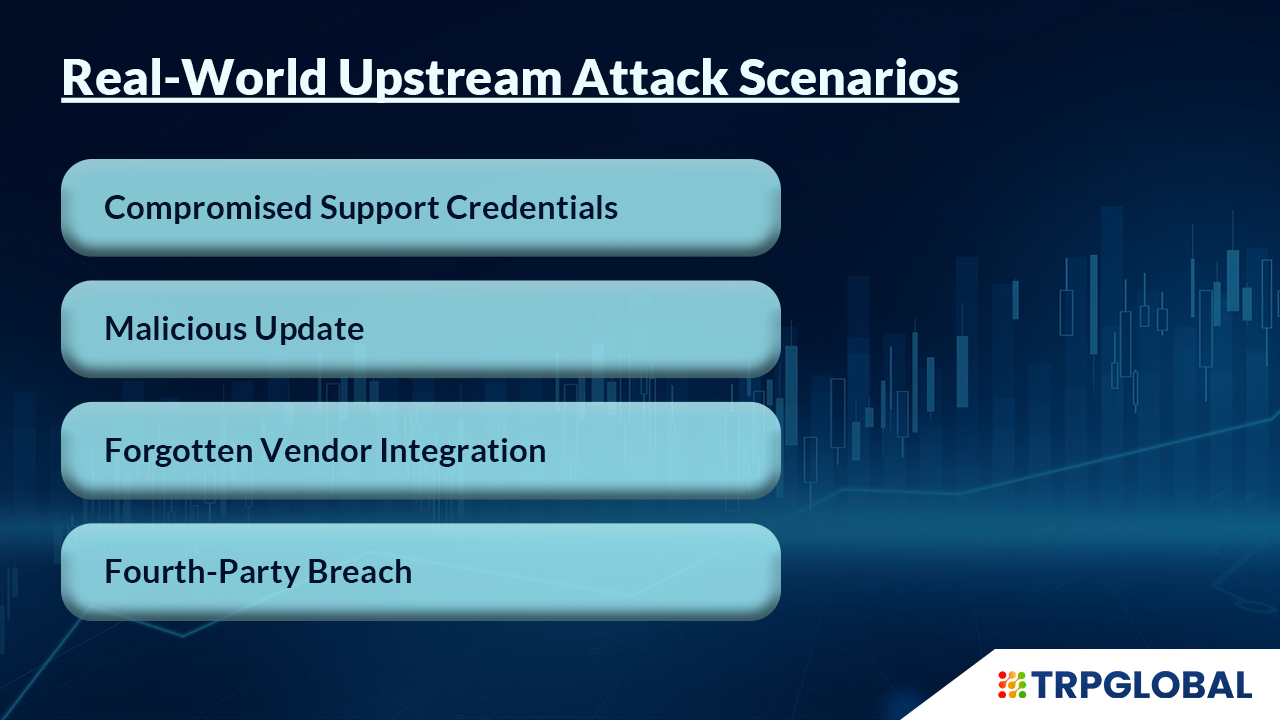
These situations occur every day.
Scenario 1: Compromised Support Credentials
A vendor’s remote access account is breached. Attackers use it to extract data slowly over months.
Scenario 2: Malicious Update
A trusted software update introduces a backdoor. No alerts trigger because the update is signed and approved.
Scenario 3: Forgotten Vendor Integration
An old API integration remains active after a contract ends. It becomes the entry point.
Scenario 4: Fourth-Party Breach
Your vendor’s subcontractor is compromised — and you never knew they existed.
None of these begins inside your security perimeter.
All of them end inside your organisation.
How Mature Organizations Manage Upstream Risk in 2026
Leading enterprises accept a hard truth:
Vendors must be treated as part of the attack surface, not external exceptions.
They adopt a different approach.
Security posture is validated continuously, not annually.
This includes:
2. Least-Privilege and Time-Bound Access
Vendor access is:
Trust is earned continuously, not granted indefinitely.
3. Extended Attack Surface Mapping
Organisations map:
Risk is prioritised where impact is highest.
4. Vendor Incident Readiness Validation
Organisational test:
Assumptions are replaced with proof.
5. Zero-Trust Applied to Third Parties
Even trusted vendors are assumed to be breachable.
Architecture is designed accordingly.
The Reality for 2026
Upstream attacks are not an emerging risk — they are the dominant attack model.
Organisations that continue to treat vendor risk as a compliance checkbox will remain exposed.
Those who treat it as a living, continuously validated risk domain will stay resilient.
Your perimeter is no longer defined by firewalls.
Your security is only as strong as the vendors you trust.
At TechRisk Partners (TRPGLOBAL), we help organisations uncover and control upstream risk by identifying vendor exposure, validating real-world access, and building continuous third-party assurance models that align with regulatory and business priorities.
If you’re ready to address the risk that doesn’t sit inside your walls, connect with us.

In our newsletter, explore an array of projects that exemplify our commitment to excellence, innovation, and successful collaborations across industries.