


Enterprise cybersecurity has never looked more mature. Organisations invest heavily in security tooling, enforce zero-trust models, deploy endpoint protection, automate patching, and monitor activity through centralised SIEM platforms processing millions of events every second.
On paper, the foundations look solid.
Dashboards are reassuring.
Audits show progress.
Risk scores appear controlled.
And yet, the Notepad++ hack exposed a hard truth that many enterprises are still unprepared to confront:
Security can fail even when everything appears to be working.
Not because of a missing control or an advanced exploit, but because trust was assumed where verification was absent.
This incident is not about a text editor.
It is about a systemic blind spot in how organisations manage supply-chain risk.
The attack involved Notepad++, a widely used tool across developer, IT, and operational environments.
Attackers did not compromise the source code.
They did not exploit a zero-day vulnerability.
They did not rely on phishing or user error.
Instead, they targeted the software update delivery mechanism.
Selected users requesting legitimate updates were silently redirected and served a malicious installer disguised as a routine update. Once installed, it deployed a stealth backdoor that enabled persistent access.
Everything looked normal.
The update was expected.
The process was approved.
The tool was trusted.
And that is exactly why it worked.
This was not a mass malware campaign.
This was not ransomware.
This was not opportunistic.
It was precise, selective, and patient — the characteristics of a modern supply-chain attack.
The attackers leveraged implicit trust:
No alarms were triggered because nothing appeared abnormal.
From a governance perspective, this is where most enterprises are vulnerable.
Most organisations believe supply-chain risk is managed once:
But the Notepad++ hack demonstrates a dangerous assumption:
If a tool is trusted, its updates must also be safe.
In reality:
And because updates are expected events, malicious activity blends into normal operations.
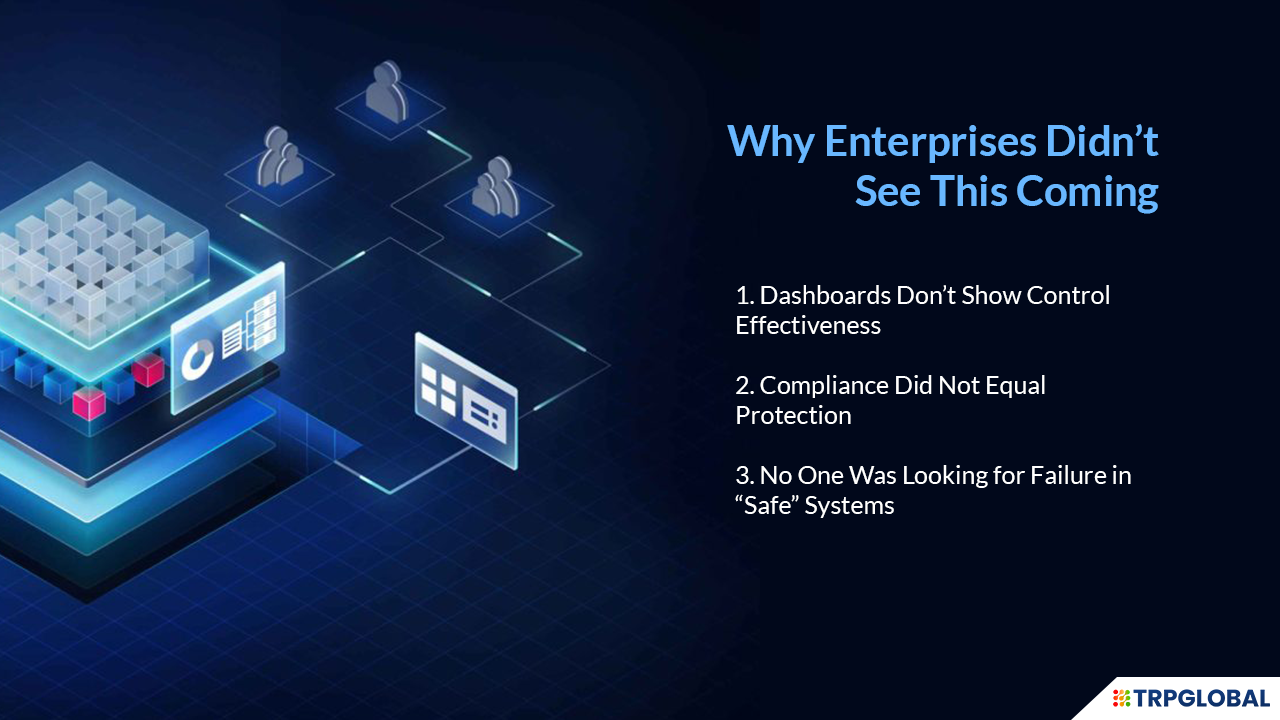
This incident did not exploit a gap in tooling.
It exploited a gap in assurance.
Security dashboards typically show:
What they don’t show:
Leadership saw stability.
The control failure remained invisible.
From an audit standpoint, everything likely passed:
But audits validate process existence, not real-time execution.
The update happened.
The policy was followed.
The organisation was still compromised.
Security teams focus attention on:
Trusted tools receive less scrutiny, especially those considered low risk.
This creates a dangerous asymmetry:
The more trusted a system is, the less it is questioned.
The Notepad++ incident is not unique. It mirrors patterns seen repeatedly across organisations.
Enterprises enable auto-updates for efficiency.
No one validates update behaviour unless something breaks.
Digital signatures are trusted implicitly even when delivery paths change.
Controls designed for one environment fail to extend to new systems, users, or update channels.
In each case, the failure is not malicious intent; it is an assurance.
This Is a Supply-Chain Risk Problem, Not a Tool Problem
The issue is not Notepad++.
The issue is not open-source software.
The issue is not automation.
The issue is how enterprises define trust.
Modern supply chains include:
Every link in that chain must be continuously verified, not trusted once and forgotten.
High-performing enterprises treat supply-chain controls as living systems.
Control presence is meaningless without validation.
Mature programs demand evidence that is:
Update mechanisms are monitored, not assumed.
Responsibility is defined clearly:
This prevents silent failures from persisting unnoticed.
Instead of reacting only to alerts, mature organisations:
This is how subtle supply-chain compromises are surfaced early.
Governance is not a document.
It is enforced inside systems.
Examples:
Governance lives where execution happens.
Change is constant.
Controls must expect failure.
Mature teams test:
Controls are treated like code, tested, monitored, and improved continuously.
The Notepad++ hack reinforces a critical leadership insight:
Risk does not come from what you don’t know exists.
It comes from what you assume is safe.
Executives often believe:
In reality:
Cyber resilience depends on visibility into truth, not confidence in design.
Every enterprise relies on trusted software.
Every enterprise enables updates.
Every enterprise assumes verification works.
The difference between resilient organisations and exposed ones is simple:
This is the shift enterprises must make.
At TechRisk Partners (TRPGLOBAL), we help organisations identify and eliminate supply-chain blind spots that traditional cybersecurity and GRC programs overlook.
We build continuous control assurance, real-time validation, and governance models that expose risk early before trust turns into liability.
If you want to strengthen your enterprise against supply-chain threats, let’s talk.

In our newsletter, explore an array of projects that exemplify our commitment to excellence, innovation, and successful collaborations across industries.