


In today’s high-stakes cybersecurity landscape, the knee-jerk response to every new threat is to buy another tool.
A new breach? Add a new scanner.
A compliance audit coming up? Grab that shiny dashboard.
A phishing campaign hits your inboxes? Time to deploy yet another filter.
It’s an understandable instinct. But here’s the problem: You can’t buy your way out of a security culture problem.
Despite billions of dollars spent on security solutions, breaches are rising. According to IBM’s Cost of a Data Breach Report, 51% of breaches in 2024 involved a human element. No tech stack no matter how advanced can compensate for poor security awareness, disengaged teams, or misaligned leadership.
It’s time to ask the hard question: Is your organization building a strong security culture or just buying a false sense of protection?
Many organizations operate under the illusion that investing in more tools equals better protection. But tool sprawl often leads to:
In short, complexity becomes the enemy of security.
A 2025 Forrester study revealed that 63% of CISOs say they have too many tools and not enough context. That’s a serious problem.
Security budgets keep growing, but ROI often flatlines. Here's why:
1. Misaligned Priorities - Many organizations invest in what looks good in a board report not what actually addresses root risks. Compliance checkboxes are satisfied while insider threats go unnoticed.
2. Low User Adoption - It doesn’t matter how powerful a tool is if your people don't use it or worse, bypass it.
3. Security as Siloed IT Work - Security is often confined to the infosec team, when it should be everyone’s responsibility—from marketing to HR to engineering.
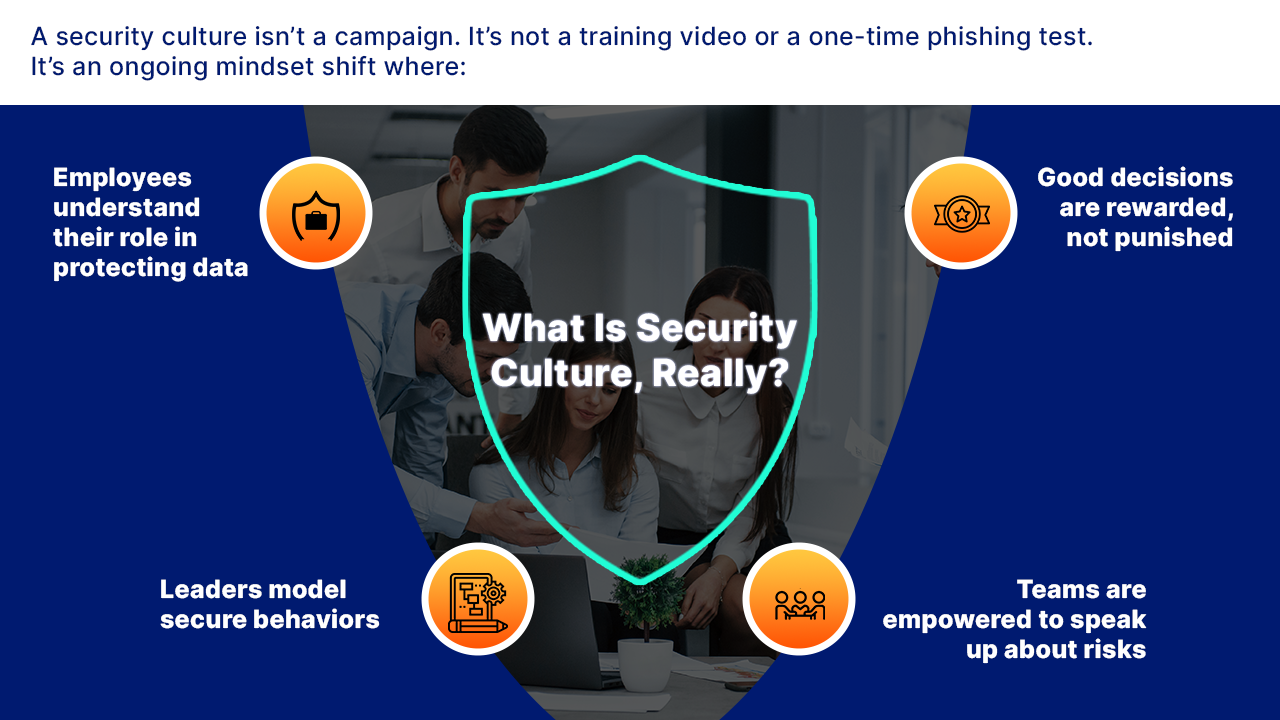
A security culture isn’t a campaign. It’s not a training video or a one-time phishing test. It’s an ongoing mindset shift where:
Good decisions are rewarded, not punished
In organizations with a strong security culture, cyber hygiene becomes muscle memory—not a checklist.
Here’s a scenario that plays out differently depending on your security culture:
Situation: A team member receives an email asking them to update their payroll information. It looks legit logo, sender, tone all feel normal.
In a tools-first culture:
In a culture-first organization:
Culture is your last line of defense and often your strongest.
You don’t need a massive budget to make meaningful progress. What you need is focus.
1. Start at the Top - Executives must walk the talk. If the C-suite reuses passwords or ignores MFA, it sets the tone.
2. Make It Everyone’s Job - Security shouldn't be a foreign language to non-technical teams.
3. Train Continuously (Not Annually) - One-off training doesn't stick. Layer learning throughout the year:
4. Gamify It - Gamification boosts engagement.
5. Celebrate Secure Behavior - People repeat what gets rewarded.
A mid-sized SaaS company with a team of 300 thought they were doing everything right: firewalls, EDR, VPN, annual training.
But they suffered a data leak when an employee forwarded an internal doc to their personal email "just to finish work at home.” The root cause? Not tool failure. Culture failure.
Following the incident, leadership launched a new initiative:
The result? 12 months later, incident reporting was up 300%, phishing click rates dropped by 78%, and security became a KPI across departments.
According to Gartner, 40% of IT teams report burnout from managing too many dashboards and disconnected alerts.
Burnout leads to:
Simplifying your stack isn’t just good for ops, it's good for security. Fewer tools, used well, beat dozens of tools used poorly.
Let’s be clear you still need tools. But tools are only as effective as the humans behind them.
What you need is balance:
How do you measure what’s often invisible? Try these KPIs:
Track over time. Share wins publicly. Iterate constantly.
If you’re tired of tool fatigue and looking for ways to embed security deeper into your organization’s DNA, we can help.
Let’s talk about:
→ Contact us to start building a security culture that actually works.

In our newsletter, explore an array of projects that exemplify our commitment to excellence, innovation, and successful collaborations across industries.