


For decades, enterprise security revolved around the network perimeter. Firewalls, intrusion detection systems, and VPNs promised to keep “outsiders” out and “insiders” safe. But in today’s cloud-dominated, hybrid, and borderless IT environments, that model has collapsed. Applications no longer sit neatly inside a controlled data center. Employees, contractors, and partners log in from anywhere. And attackers? They exploit this sprawl relentlessly.
In this post-cloud reality, identity has emerged as the new security perimeter. If you can’t control who gets access to what, and under what conditions, no amount of firewalls or endpoint monitoring will save you. This is why Identity and Access Management (IAM) has become the backbone of modern cybersecurity. Done right, IAM reduces risk, improves compliance, and perhaps most importantly builds trust in a fragmented digital ecosystem.
Cloud migration, SaaS adoption, and remote work have decoupled users from traditional networks. The critical truth: every access request is now a potential breach point. Instead of relying on static defenses, organizations must treat identity itself as the gatekeeper.
The result? Security leaders recognize that IAM is no longer just an IT function it’s a business imperative.
The shift to identity as perimeter is not just a trend—it’s a response to real breaches. Some sobering statistics:
When identity is neglected, attackers can move laterally, escalate privileges, and exfiltrate sensitive data often without triggering network alarms.
So what does strong IAM actually mean in practice? Here are the pillars that define maturity in a post-cloud environment:
Unifying directories and credentials reduces silos. Single sign-on (SSO) ensures seamless yet secure access across cloud and on-premises applications.
Passwords alone are dead. MFA—biometric, token-based, or app-based—significantly reduces credential theft risks.
IAM must be context-aware. A login from an unusual location, device, or time should trigger additional verification.
Users should only have access they truly need. Automating provisioning and de-provisioning prevents privilege creep.
IAM is not “set and forget.” Ongoing audits, anomaly detection, and compliance tracking keep identity controls effective.
Consider the 2023 Uber contractor breach. An attacker tricked a contractor into accepting an MFA push, gaining access to critical systems. The lesson: even companies with IAM tools in place can fail if controls are not holistic and adaptive.
Contrast this with a financial services firm that adopted risk-based IAM, integrating device trust scores, geolocation, and behavioral analytics. Phishing attempts spiked, but suspicious logins were automatically challenged, stopping attackers cold.
Beyond security, IAM drives measurable business value:
Traditional IAM systems were rules-based and static. Today’s AI-enhanced IAM platforms use machine learning to detect anomalies and adapt policies dynamically. For example:
AI turns IAM into a proactive defense mechanism predicting risk before it manifests.
Zero Trust architectures place IAM at the center. Every user, device, and application must prove trustworthiness continuously. But IAM will also evolve into Identity Threat Detection and Response (ITDR) , a Gartner-defined discipline focused specifically on detecting identity abuse.
Enterprises that fail to adopt Identity First Security risk being left behind not just technologically but competitively. In a post-cloud world, trust is the currency of business, and IAM is how you mint it.
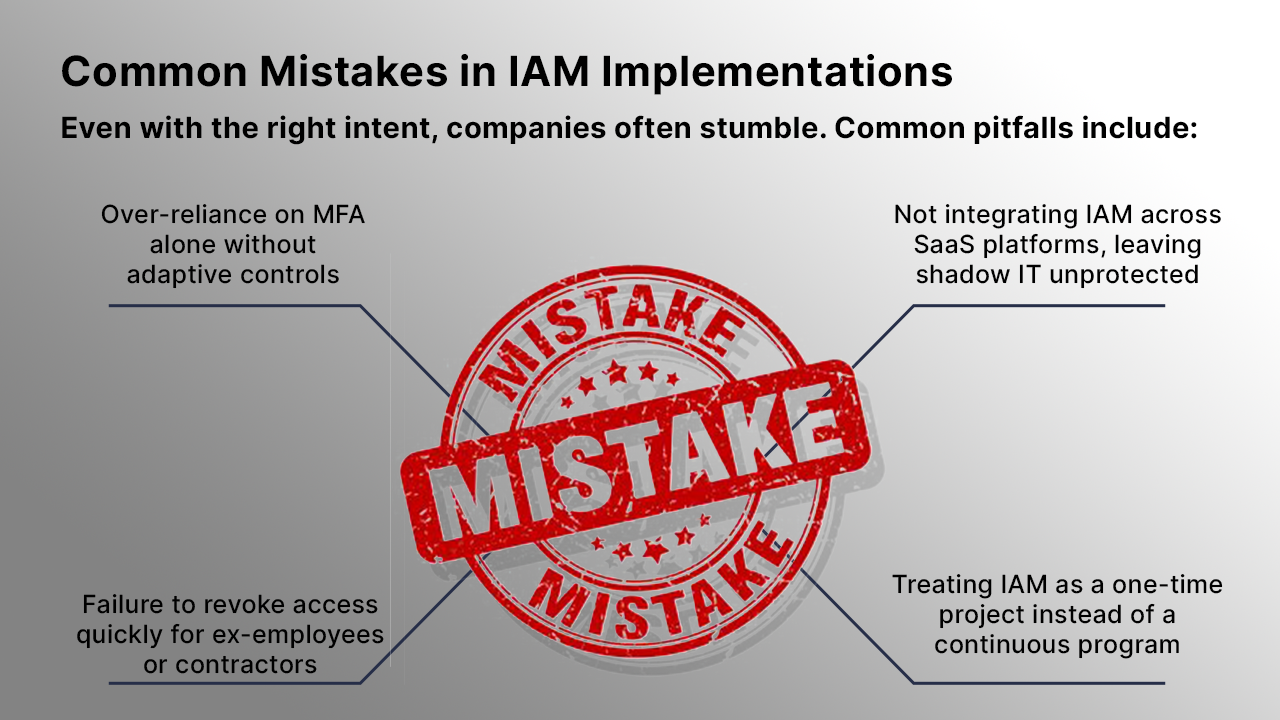
Even with the right intent, companies often stumble. Common pitfalls include:
Avoiding these mistakes requires a strategic, governance-driven approach
Much like unmanaged technical debt, identity debt accumulates silently as organizations delay proper IAM practices. Every unrevoked credential, misconfigured role, or bypassed policy adds up to exploitable risk. Left unchecked, this “identity debt” becomes a ticking time bomb one that attackers are more than happy to exploit. Treating IAM as a living program rather than a one-off project is how enterprises avoid carrying forward vulnerabilities that only grow more dangerous with scale.
Here’s a practical roadmap:
Your IAM strategy is no longer optional; it's foundational. If your enterprise is still relying on perimeter defenses, it’s time to re-think. Get in touch with our security experts today to evaluate your IAM maturity and start building an identity-first defense strategy.

In our newsletter, explore an array of projects that exemplify our commitment to excellence, innovation, and successful collaborations across industries.