


India’s banks operate in a high-trust, high-regulation environment, where customer confidence, data security, and regulatory compliance are non-negotiable. From digital payments and mobile banking apps to cloud-hosted core banking systems and outsourced IT operations, banks increasingly rely on third-party vendors to deliver speed, innovation, and scalability.
However, every new vendor relationship also introduces operational, cyber, compliance, and reputational risks. A single weak link in the vendor ecosystem can expose banks to data breaches, service outages, regulatory penalties, and loss of customer trust.
With regulatory oversight tightening and cyber threats becoming more sophisticated, third-party risk management (TPRM) has evolved from a back-office compliance task into a board-level priority. Artificial Intelligence (AI) is now playing a transformative role in helping Indian banks manage this growing risk landscape—intelligently, continuously, and proactively.
The Expanding Third-Party Risk Landscape in Indian Banking
Modern Indian banks work with hundreds or even thousands of third parties, including:
These third parties are deeply embedded into daily banking operations. While they enable innovation and efficiency, they also expand the bank’s attack surface and compliance exposure.
Each third party can directly impact a bank’s:
Indian regulators make it clear: banks remain accountable for their vendors.
Regulatory Pressure Is Driving the Need for Continuous Oversight
Regulations from bodies such as:
require banks to maintain strong governance and continuous oversight over their third-party ecosystem.
The challenge today is no longer identifying who the vendors are.
The real challenge is monitoring vendor risk continuously, across cybersecurity posture, compliance readiness, operational resilience, and data protection—without slowing down business growth.
Why Traditional Third-Party Risk Management Is Falling Short
Conventional TPRM approaches have historically relied on:
While these methods were sufficient in a less complex environment, they are now proving inadequate.
Key Limitations of Traditional TPRM
In today’s digital banking environment, risks can emerge in weeks or even days. Annual or quarterly reviews simply cannot keep pace with the speed of modern threats.
How AI Is Transforming Third-Party Risk Management
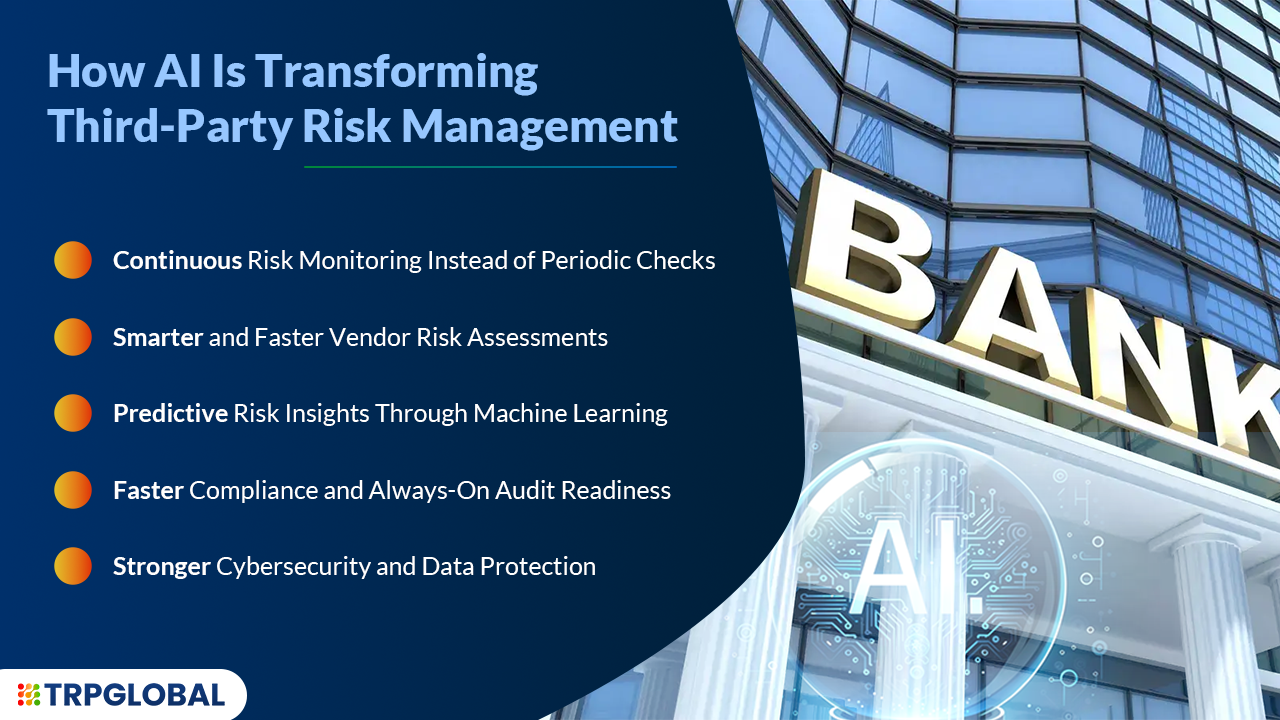
AI introduces automation, intelligence, and adaptability into TPRM—transforming it from a periodic compliance exercise into a continuous, data-driven risk management process.
Instead of asking, “Was the vendor compliant last year?”, AI helps banks ask,
“Is this vendor safe right now—and will it remain so tomorrow?”
1. Continuous Risk Monitoring Instead of Periodic Checks
AI-driven platforms continuously monitor vendors by analyzing:
This enables banks to detect risk shifts in real time, rather than waiting for audits or vendor self-declarations.
As a result, banks can:
2. Smarter and Faster Vendor Risk Assessments
AI significantly improves vendor onboarding and assessment by:
Instead of applying the same scrutiny to all vendors, banks can now prioritize high-risk vendors instantly, while streamlining assessments for lower-risk partners.
This leads to faster onboarding without compromising security or compliance.
3. Predictive Risk Insights Through Machine Learning
Machine learning models analyze vast datasets, including:
This enables banks to:
Predictive insights are especially valuable when managing large, complex vendor portfolios where manual monitoring is impractical.
4. Faster Compliance and Always-On Audit Readiness
AI-driven TPRM solutions help banks:
This dramatically reduces audit preparation time and ensures banks remain inspection-ready at all times, not just during audit season.
5. Stronger Cybersecurity and Data Protection
With third-party cyber incidents on the rise, AI enhances security by:
For Indian banks handling sensitive customer and financial data, this level of visibility is no longer optional, it is essential.
The Business Impact of AI-Driven TPRM
Banks adopting AI-enabled third-party risk management experience:
More importantly, AI allows risk and compliance teams to focus on decision-making and strategy, rather than manual data collection and reporting.
From Compliance Obligation to Strategic Advantage
AI is not replacing human judgment—it is enhancing it.
For India’s banks, AI-driven TPRM represents a shift from:
Banks that embrace intelligent risk platforms will be better positioned to:
As India’s banking ecosystem becomes more interconnected, third-party risk is no longer a side concern—it is a critical determinant of trust, resilience, and regulatory confidence. AI is reshaping third-party risk management by enabling continuous monitoring, predictive insights, and faster compliance in an environment where speed and accuracy matter more than ever.
For banks, the shift is clear: moving from manual, reactive processes to intelligent, always-on risk management is no longer optional—it’s essential.
Contact us, as it helps Indian banks make this transition seamlessly.
Our AI-driven third-party risk and compliance solutions provide real-time visibility, audit readiness, and proactive risk control—so banks can innovate confidently while staying compliant in an increasingly complex regulatory landscape.

In our newsletter, explore an array of projects that exemplify our commitment to excellence, innovation, and successful collaborations across industries.