


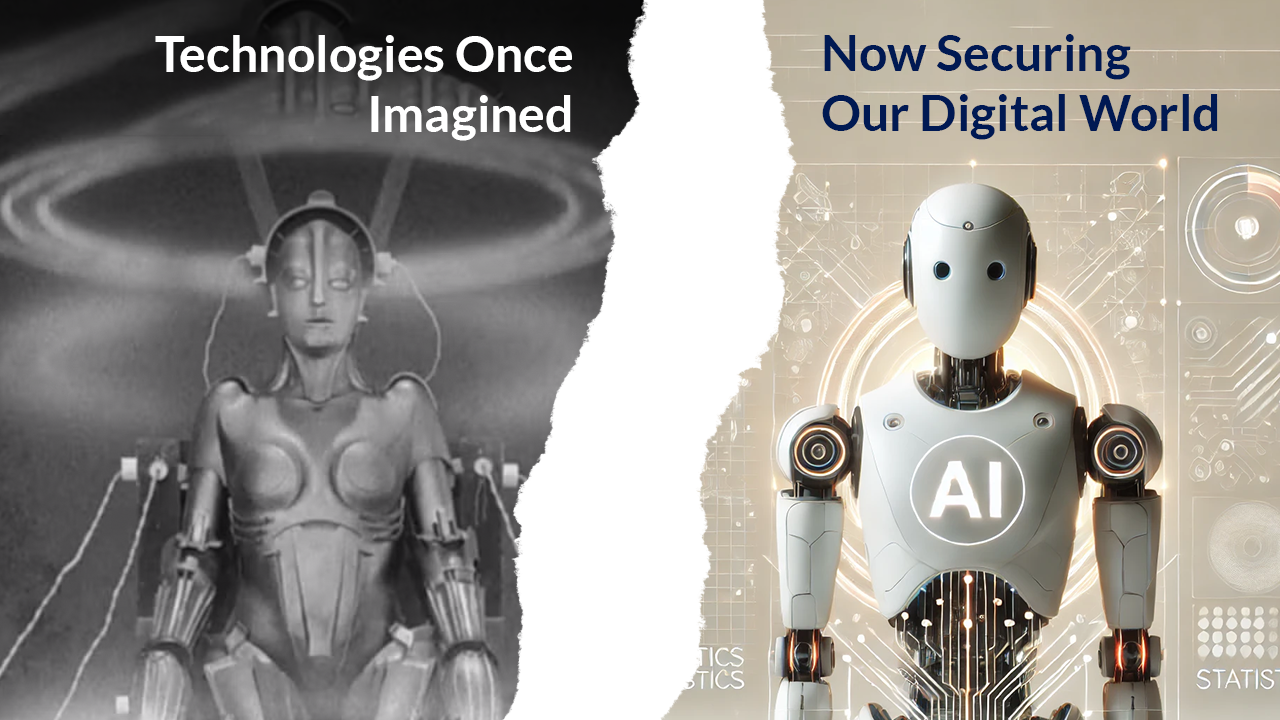
If you watched Minority Report and thought pre-crime surveillance was far-fetched, think again. If Blade Runner’s biometric scanners felt futuristic, look around — your phone does that now. Cybersecurity has quietly — and rapidly — absorbed technologies that were once relegated to sci-fi movies and novels.
We’re now living in an era where the imagination of storytellers has become the blueprint for security architects. From AI-driven anomaly detection to behavioral biometrics and quantum encryption, the lines between fiction and real-world defense are vanishing.
This is no longer about catching up. It’s about staying ahead — because attackers are evolving just as fast.
Remember when Star Trek characters entered restricted zones via retina scans? Or when agents in Mission: Impossible used fingerprints and voice authentication?
Those concepts are now commercial security standards. Today, biometric authentication is common in:
Why it matters: Biometrics reduce the reliance on passwords — still one of the weakest links in enterprise security. Behavioral biometrics (like typing rhythm or mouse movement) are increasingly used to verify identity invisibly and continuously.
Business impact: Faster, more secure user experiences. Reduced risk of credential theft. Better fraud prevention, especially in banking and telecom sectors.
In Minority Report, predictive analytics were used to stop crime before it happened. Sound familiar?
AI and machine learning are now fundamental to cybersecurity platforms. Systems can:
Real-world use case: Companies like Darktrace, CrowdStrike, and Microsoft use AI models that adapt to new threat behaviors in real time. They don’t just look for known signatures — they understand normal and flag what’s not.
Why it matters: Human-led SOCs can’t scale with today’s attack volume. AI buys time, scales detection, and turns noisy alerts into actionable insights.
Imagine a system that knows it’s you, not because you typed your password, but because you moved your mouse the way you always do.
That’s behavioral analytics — a technology inspired by neurometrics and surveillance concepts from spy fiction. It uses:
To continuously verify user identity and detect anomalies — often before fraud happens.
Real-world use case: Banks and fintechs use behavioral biometrics to detect account takeover attempts, insider threats, and bot attacks — without impacting the customer experience.
Why it matters: It enables invisible security — frictionless for users, frustrating for attackers.
Quantum computing may still sound futuristic, but it’s already reshaping security.
Why? Because current encryption methods (like RSA) rely on problems that quantum computers can solve in seconds. The sci-fi solution? Post-quantum cryptography — or using quantum principles to create encryption so complex it’s virtually unbreakable.
Who's leading this? IBM, Google, and the U.S. National Institute of Standards and Technology (NIST) are racing to develop and standardize quantum-resistant encryption.
Business relevance: Organizations — especially in finance, defense, and healthcare — need to start preparing today. Quantum risk isn’t theoretical. It’s timeline-sensitive.
Ever seen a movie where an agent triggers a fake escape route, leading the pursuer into a trap? That’s the idea behind cyber deception.
Deception technologies deploy:
To lure and trap attackers, triggering alerts and collecting forensic data.
Use case: Some use deception as part of their layered defense — especially for protecting high-value assets like financial systems or PII databases.
Why it matters: It turns the attack surface into a minefield. Instead of passively monitoring, you’re actively misleading the adversary.
The rise of voice-based deepfakes — think synthetic CEO calls requesting wire transfers — has become a real threat.
In response, security tools now analyze:
To flag fake audio signatures.
Why it matters: Fraud prevention now includes protecting your voice. As AI-generated media rises, brand, executive, and customer impersonation risks demand serious defenses.
Scene: A person enters a building, their facial recognition is matched, their mobile device proximity confirmed, their behavior is compared to baseline — all in milliseconds.
This already exists in:
Why it matters: Modern surveillance blends physical and cyber defense. In high-risk environments, access and activity are no longer separate security domains — they’re one continuous posture.
Science fiction gave us the vision. Technology brought it to life. But most enterprises haven’t caught up.
If your security stack is still focused on perimeter firewalls and password rotation, you’re defending the present with tools of the past — while your adversaries use tools of the future.
Forward-thinking organizations are already:
These aren’t moonshots — they’re table stakes in 2025.
From the sci-fi shelves to your SOC, today’s cybersecurity landscape reflects the imaginations of yesterday’s futurists. The only difference? The stakes are real.
Attackers move fast, adapt quickly, and use innovation as leverage. So should you.
Security is no longer about hardening the walls. It’s about designing a system so adaptive, intelligent, and deceptive that attackers can’t find footing.
As we move deeper into a world powered by AI, machine learning, and quantum computing, the organizations that thrive will be those that treat innovation not as a buzzword — but as a blueprint. For more such information Contact us Now!!

In our newsletter, explore an array of projects that exemplify our commitment to excellence, innovation, and successful collaborations across industries.