


With the economy constantly shifting and evolving, managing financial risks has never been more important. Financial risk management (FRM) isn’t just a technical skill—it’s a lifeline for businesses and individuals who want to safeguard their finances and seize opportunities in uncertain times. It’s about more than just avoiding losses; it’s about spotting potential threats before they become problems and turning them into profitable moves. This article dives into why financial risk management matters, what risks we face, and the smartest ways to keep them in check.
Financial risk management is the process of evaluating and implementing strategies to control financial risks. These risks can stem from market volatility, credit defaults, liquidity shortages, operational inefficiencies, and regulatory changes. The goal of FRM is not to eliminate risk entirely—an impossible feat—but to understand and control it so that informed decisions can be made.
1. Protecting Assets - One of the primary reasons businesses and individuals need financial risk management is asset protection. Financial markets are prone to rapid changes, and without a robust risk management strategy, the value of investments or a business's assets can plummet unexpectedly. FRM helps safeguard these assets by anticipating potential downturns and preparing appropriate responses.
2. Stability During Volatility - Economic fluctuations are inevitable. Whether due to market crashes, global pandemics, or geopolitical tensions, these instabilities can severely impact financial standing. Effective financial risk management ensures that companies and individuals remain stable during such periods by maintaining strategic reserves, diversifying investments, and utilizing hedging techniques.
3. Informed Financial Decisions - Making informed financial decisions is critical in today’s complex financial landscape. FRM provides the tools needed to assess potential risks and their impacts before committing resources. By understanding risks thoroughly, decision-makers can take calculated actions rather than impulsive ones, improving outcomes and reducing the chance of significant losses.
4. Compliance and Legal Safeguards - In an environment where regulatory standards are becoming more stringent, non-compliance can lead to fines, legal battles, and reputational damage. FRM ensures that companies stay within regulatory boundaries, protecting them from financial and legal repercussions.
5. Long-Term Planning and Growth - Financial risk management isn't just about protecting against negative outcomes; it also supports long-term planning and growth. By managing risks proactively, businesses can pursue strategic initiatives with greater confidence, knowing that potential pitfalls are accounted for and controlled.
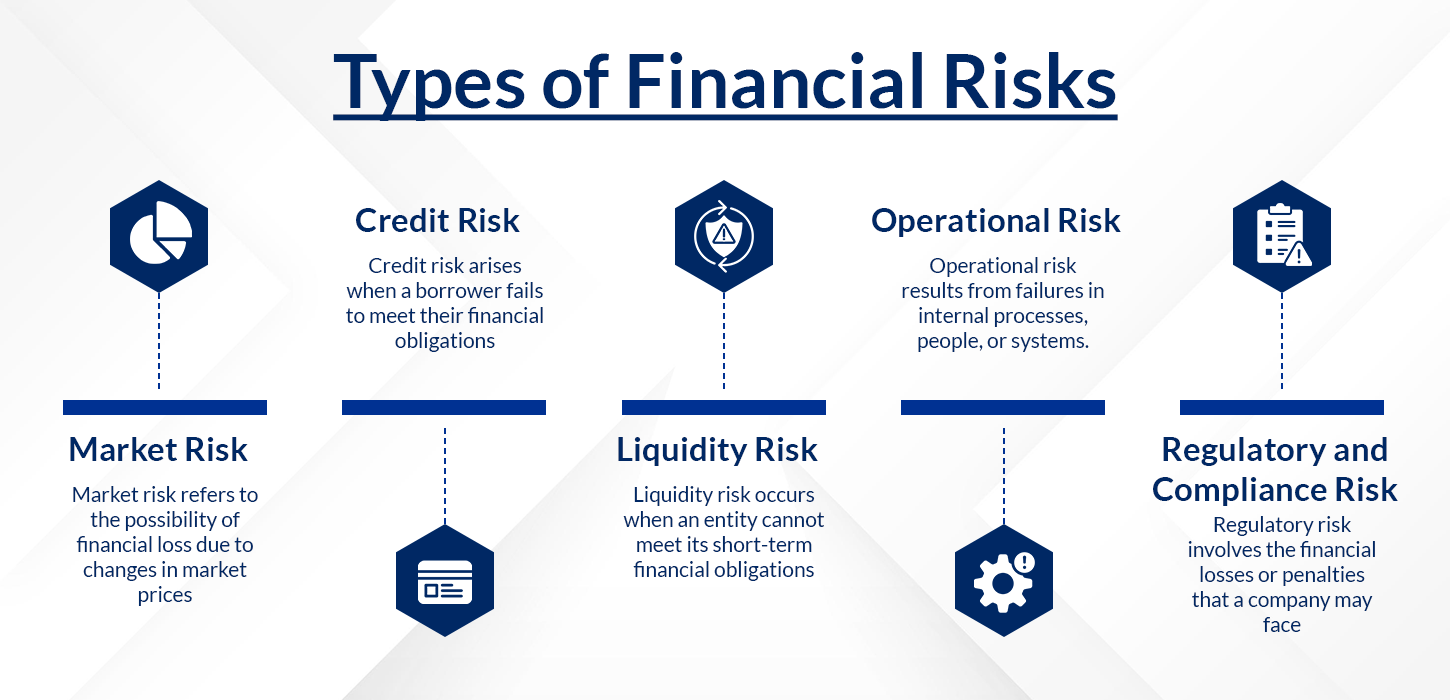
Understanding the different types of financial risks is essential to develop effective management strategies. Here are the primary types of financial risks:
1. Market Risk - Market risk refers to the possibility of financial loss due to changes in market prices. This includes stock prices, interest rates, and currency exchange rates. For example, an unexpected spike in interest rates can increase the cost of borrowing, impacting a company’s profitability.
2. Credit Risk - Credit risk arises when a borrower fails to meet their financial obligations. This can affect banks, investors, and companies that extend credit to customers. Effective credit risk management involves assessing the likelihood of default and implementing measures such as credit scoring and collateral requirements.
3. Liquidity Risk - Liquidity risk occurs when an entity cannot meet its short-term financial obligations because it lacks sufficient liquid assets. Companies need to have cash flow management strategies in place to ensure they can meet their financial commitments when needed.
4. Operational Risk - Operational risk results from failures in internal processes, people, or systems. This could include anything from a software malfunction to human error or fraud. Mitigating operational risk involves robust process management, employee training, and investing in reliable technology.
5. Regulatory and Compliance Risk - Regulatory risk involves the financial losses or penalties that a company may face if it fails to comply with relevant laws and regulations. This type of risk has grown in importance with the increasing complexity of financial regulations worldwide.
Ensuring Long-Term Sustainability - Financial risk management is vital for the long-term sustainability of any business or investment portfolio. It prepares companies and individuals to withstand financial shocks, allowing them to continue operating effectively despite adverse conditions.
Enhancing Investor Confidence - Investors are more inclined to support businesses that demonstrate strong risk management practices. When a company shows it can manage potential losses effectively, it boosts investor confidence and attracts capital investment.
Gaining a Competitive Advantage - Organizations that excel in financial risk management often gain a competitive advantage. They are more agile and better positioned to seize opportunities that may appear risky to less prepared competitors. By carefully analyzing risk and reward, these companies can make bold, strategic moves that lead to growth and market leadership.
1. Risk Identification and Assessment - The first step in any risk management strategy is to identify and assess all potential risks. This involves conducting comprehensive analyses using tools such as SWOT (Strengths, Weaknesses, Opportunities, and Threats) and PEST (Political, Economic, Social, and Technological) to map out internal and external risks.
2. Risk Measurement - Quantifying risk is essential for prioritization. Metrics such as Value at Risk (VaR), stress testing, and scenario analysis help measure the potential impact of different risks. These tools offer insights into potential losses under varying conditions, enabling better preparation.
3. Developing Risk Mitigation Strategies - Effective risk mitigation involves implementing strategies tailored to specific types of risks:
4. Leveraging Technology and Automation - Modern financial risk management heavily relies on technology. AI and machine learning tools can identify patterns, predict potential risks, and automate processes that were once manual and time-consuming. Automation helps reduce human error and ensures that risk management practices are applied consistently across an organization.
5. Establishing Strong Governance and Compliance Frameworks - A well-defined governance structure is critical for financial risk management. This includes setting up dedicated risk management committees and aligning policies with the overall business strategy. Adhering to governance standards ensures that risk management remains a top priority and that compliance with regulatory requirements is maintained.
Case Studies: Learning from Leaders
Case Study 1: A Leading Financial Institution - A major financial institution serves as an excellent example of effective financial risk management. Its diversified approach to credit and market risks allowed it to remain stable during a major financial crisis while many other institutions faced significant challenges. By employing stress testing and hedging strategies, it minimized losses and maintained investor confidence.
Case Study 2: A Global Manufacturing Leader - A prominent global manufacturer with international operations faces significant currency exchange risks. To counteract these potential impacts, it employs currency hedging strategies and diversifies its revenue sources geographically. This proactive approach helps it navigate fluctuations in foreign exchange rates without significant financial setbacks.
Continuous Monitoring and Adaptation - Financial risks are not static; they evolve with changes in the market, regulations, and internal factors. Continuous monitoring allows companies to stay ahead of new risks and adapt their strategies accordingly.
Employee Training and Awareness - A culture of awareness and accountability is essential. Training employees to understand basic risk management practices helps ensure that risk considerations are part of everyday decision-making.
Leveraging Data Analytics - Data-driven insights enhance decision-making and allow for a proactive approach to risk. By utilizing predictive models, organizations can anticipate future risks and develop strategies to manage them effectively.
Financial risk management goes beyond simply protecting a business or investment—it enables growth and innovation. By understanding and mastering the art of managing risk, companies and individuals can turn uncertainty into opportunity. Effective risk management not only protects against losses but also sets the stage for long-term success by providing the confidence to make bold, informed decisions.
Embracing comprehensive FRM practices, leveraging technology, and fostering a culture of continuous improvement will position businesses to thrive in an environment where change is constant. In doing so, they transform potential threats into stepping stones for growth and resilience.

In our newsletter, explore an array of projects that exemplify our commitment to excellence, innovation, and successful collaborations across industries.