Cybercriminals are rewriting the playbook. The goal isn’t just locking your data anymore, it's owning your data.
Attackers now steal information quietly and use it to pressure organizations, customers, partners, and suppliers. Even if backups restore systems, the real danger remains: public exposure.
So what changed and how do you defend against a threat that doesn’t start with encryption?
Let’s break it down.
Why Data Extortion Is Replacing Ransomware
The Shift From Encryption to Exposure
The ransomware business model became less reliable for attackers. Organizations are better prepared with:
Backups
Rapid recovery plans
Incident playbooks
So criminals found a more profitable angle: leak threats.
Steal confidential data
Use regulatory and reputational pressure
Force payment even if systems are restored
Your data becomes the blackmail material.
Multi-Extortion Is the New Default
Attackers now go beyond encryption:
Double extortion: Encrypt + leak
Triple extortion: Add DDoS + media pressure
Collateral extortion: Target customers & vendors to squeeze payment
In short, more leverage counts to higher payout.
How Data Extortion Attacks Work
Attackers don’t want to be noticed until they do.
Here’s their typical playbook:
Breach: phishing, compromised credentials, shadow IT access
Blend in: quietly extract data for weeks
Apply pressure: threats via leak sites, media, legal angles
By the time anyone knows, the data is already gone.
What Data Attackers Want Most
Because value is everything:
PII (financial, health, identity data)
Employee/customer confidentiality
Operational reports & internal communications
Intellectual property
Almost anything can be weaponized.
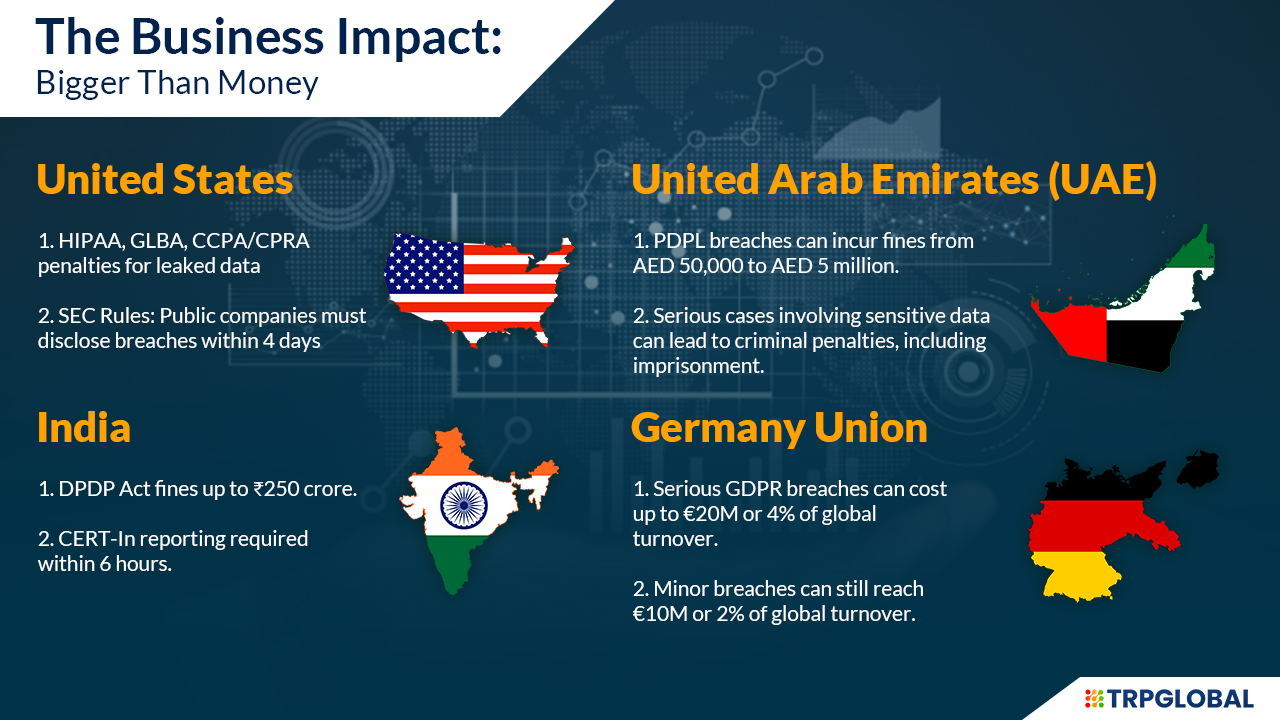
The Business Impact: Bigger Than Money
This isn’t just downtime, it's corporate survival.
Regulatory Exposure
United States
HIPAA, GLBA, CCPA/CPRA penalties for leaked data
SEC Rules: Public companies must disclose breaches within 4 days
United Arab Emirates (UAE)
Under the UAE Personal Data Protection Law (PDPL), non-compliance or data breaches can lead to fines ranging from AED 50,000 up to AED 5 million (approx. USD 1.36 million), depending on the severity.
In severe cases involving sensitive data (e.g. banking or health information), breaches may trigger criminal liability — fines, corrective orders, or even imprisonment under associated cyber-crime laws.
Germany / European Union
Businesses under the General Data Protection Regulation (GDPR), applicable in Germany via national legislation such as Federal Data Protection Act (BDSG), face fines of up to €20 million or 4% of global annual turnover, whichever is higher — for serious violations.
Even “less severe” infringements under GDPR can incur fines up to €10 million or 2% of global turnover.
National fines under BDSG may also apply for specific violations, such as incorrect handling of information-requests or failure to inform data subjects, with administrative sanctions that can compound the GDPR-level risk.
India
DPDP Act fines up to ₹250 crore
CERT-In reporting required within 6 hours
Brand & Legal Fallout
Loss of customer trust
Lawsuits and compensation claims
Investor backlash
PR damage across markets
A single leak can change the story of your business forever.
How to Prepare for Data Extortion in 2026
You don’t need “more tools.” You need smarter, coordinated protection:
Secure the Data First
Data Loss Prevention (DLP)
Encryption at rest & in transit
Immutable, tested backups
Zero Trust access policies
2. Strengthen Identity Controls
MFA or passwordless authentication
Privileged access governance
Real-time user activity monitoring
3. Build Extortion Response Readiness
Incident response runbooks
Dark web exposure monitoring
Legal & communication plan aligned with regulations
4. Train Employees as a Security Advantage
Ongoing phishing simulations
Insider risk awareness
Role-tailored cybersecurity training
The strongest defense is human awareness backed by technology that actually works.
The Future of Data Extortion
Expect 2026 to bring:
AI-powered attack automation
Larger supply chain extortion
“Cybercrime franchising” through Extortion-as-a-Service
Cybercrime isn’t slowing down. It's scaling like a business.
Final Thoughts
Data is the new hostage. Attackers don’t want to disrupt operations,They want to control your information. Organizations that evolve their defenses will remain resilient in the year ahead. Those that don’t… will pay for it.
Contact Us to Protect Your Data & Reputation. Cause we help organizations:
Predict threats
Prevent exposure
Protect business continuity & compliance
Secure your 2026 with confidence. Let’s secure your future together.
In our newsletter, explore an array of projects that exemplify our commitment to excellence, innovation, and successful collaborations across industries.
Thank you! Your submission has been received!
Oops! Something went wrong while submitting the form.